
Hotel near Poitiers: 331 kWp solar carport + 520 kWh BESS
How a franchised hotel near Poitiers turns the French APER law mandate into an economic lever: 331 kWp carport + 520 kWh Battwoo battery, 33,000 € projected annual savings through self-consumption.
- Solar self-consumption
- APER law compliance
- EV charging
- PV peak power
- 331 kWp
- Storage capacity
- 520 kWh (Battwoo)
- Hybrid inverters
- 2 × 100 kW
- Projected annual saving
- 33,000 €
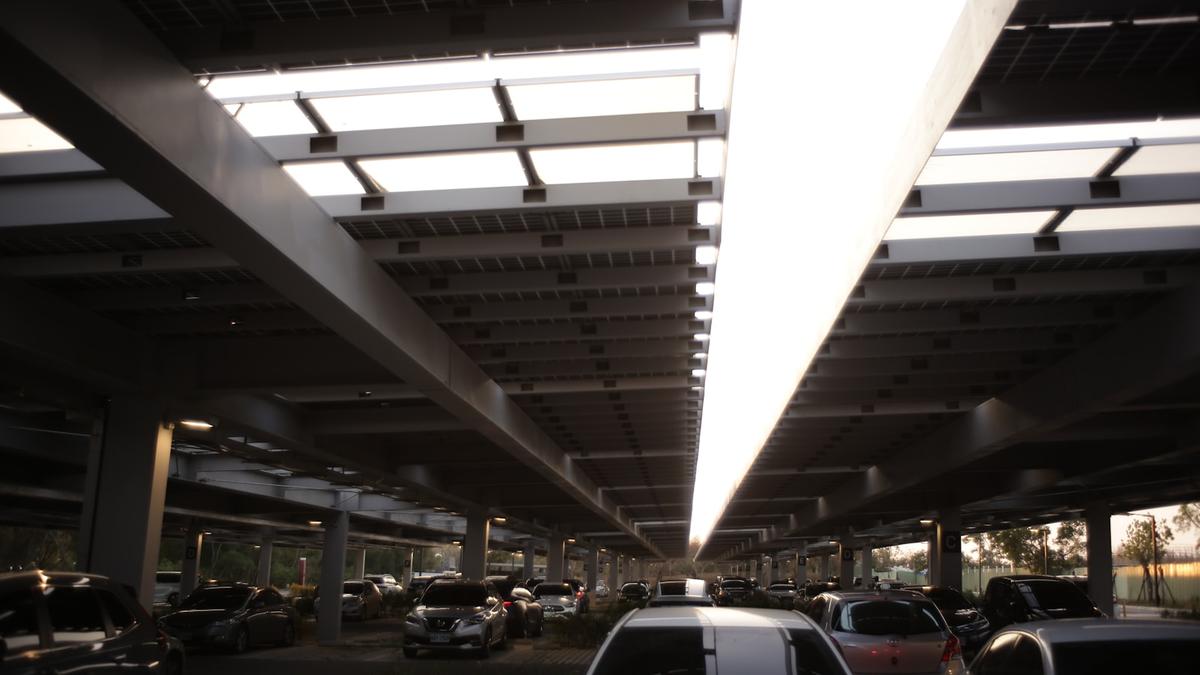
A franchised hotel near Poitiers asked us to turn a regulatory mandate into an economic lever: the French APER law requires the site to equip its parking lot with photovoltaic carports. Rather than absorb the investment, the owner wants to make it profitable while adding EV charging stations for guests. Here is how our techno-economic study connects both needs around a 520 kWh stationary BESS.
A hotel facing the French APER law: obligation or opportunity?
Since 1 July 2023, the APER law (Acceleration of renewable energy production, March 2023) requires operators of outdoor parking lots above 1,500 m² — covering nearly every franchised hotel on the outskirts of French cities — to equip at least half of the surface with photovoltaic carports.
For our client, this mandate meant several hundred thousand euros of compliance investment. But also an opportunity: modernising the guest experience by adding EV charging stations, increasingly expected in the mid-market hospitality segment.
Two needs that called for a joint reading — and that shaped our study.
Why self-consumption beats feed-in tariffs in 2026
The historical reflex for any PV install is to feed surplus back into the grid via a regulated purchase contract. In 2026, that model has lost its appeal:
- Feed-in tariffs cut by 3 in 5 years — the steady decline of CRE tariffs for installs < 500 kWp has made re-selling marginal against the cost of grid purchases.
- Grid price volatility — peak-hour cost on the French yellow tariff regularly exceeds 200 €/MWh in winter peak (CRE, 2025).
- Grid saturation — some local DSOs limit new injections under local network constraints.
Our study concluded: self-consuming each produced kWh displaces ~ 200 €/MWh of grid purchase. Re-selling brings only 40-60 €/MWh. The gap is 3-4× more profitable on the self-consumption side.
The remaining question: how to align solar production (daytime peak) with hospitality consumption (spread across the day with evening and overnight EV charging peaks). That is the BESS role — see our guide Load curve analysis before a BESS project.
The solution sized by Battwoo
Our techno-economic study landed on a PV + BESS + inverter trio calibrated against the site's real consumption profile.
331 kWp photovoltaic carport
A galvanised-steel carport covering ~ 2,100 m² of parking surface, fitted with monocrystalline TOPCon modules. The 331 kWp peak power exceeds the APER minimum required for the relevant surface — a deliberate over-sizing to maximise daytime production destined for storage.
520 kWh Battwoo battery (second-life modules)
A 520 kWh stationary storage unit built from EV battery modules diagnosed for a second life. Capacity covers the gap between daytime PV output and evening/overnight hospitality consumption — especially guest EV charging sessions after check-in.
The second-life path divides the battery's embedded carbon footprint by 4 compared with an equivalent new-cell unit, and cuts upfront investment by about 30 % at comparable stationary performance.
Hybrid inverters 2 × 100 kW
Two 100 kW hybrid inverters, redundant: they simultaneously manage PV → battery, battery → site, and grid → battery flows (for programmed off-peak charging). If one inverter fails, the second maintains 50 % of operational power — a robustness standard for a hotel site that cannot tolerate unplanned outages.
Projected results: 33,000 € savings in year one
Our 12-month economic model returns:
- 33,000 € annual savings on the electricity bill from year one, captured mainly via self-consumption (kWh produced + stored = kWh not bought at yellow-tariff peak rate).
- Self-consumption rate > 80 % — vs ~ 50 % without storage on the same PV.
- EV charging stations powered mostly by stored energy, without straining the site's grid subscription.
- APER compliance achieved across the relevant parking surface — fine risk neutralised.
The economic model flips the APER investment from a forced cost into an asset that pays back over 6 to 8 years depending on tariff exposure.
Why this model fits hospitality
Three traits make hospitality particularly suited to a carport + BESS pairing:
- Large under-utilised parking surface — the carport turns a sterile area into an energy generator without displacing existing activity.
- Bimodal consumption profile — evening peaks (kitchen, restaurant, AC, guest-arrival EV charging) are well aligned with the peak-to-off-peak shift enabled by storage.
- EV charging = premium service — increasingly expected by both business and tourism guests, who pick their hotel on that criterion (and stay longer).
To assess a similar project at your site, request a personalised Battwoo study.
Frequently asked questions
How long do the works take for a project of this size?
12 to 18 weeks on average: 4-6 weeks of manufacturing and preparation, 4-8 weeks of carport installation, 1-2 weeks for the battery + inverters, 1-2 weeks for commissioning and Enedis connection.
What is the full payback period?
On this project size (331 kWp + 520 kWh), the complete payback (CAPEX net of incentives) lands between 6 and 8 years depending on the grid tariff and EV charger utilisation.
What happens during a grid outage?
With the hybrid inverters specified, a partial backup function can be activated: critical loads (fire-safety, emergency lighting, reception desks) stay powered for 4-8 hours depending on the battery state of charge at the moment of the outage.
Should the client buy or lease the system?
Several structures exist: direct purchase (CAPEX), third-party investor (PPA with an operator who finances and operates), or leasing. Our study includes a comparison of the three tax and cash-flow scenarios.
What is the expected battery lifetime?
Under the projected use (1 cycle/day, average 80 % depth), expected useful life is 10-12 years, backed by a Battwoo performance warranty preserving capacity above 70 % over the period.
About this case study
Techno-economic study delivered by Battwoo. Project sized and costed, not yet built at publication date. The savings shown are projections, based on the site's consumption profile, regulated tariffs in force (CRE 2025) and EV charging utilisation calibrated on sector benchmarks. To assess a similar project on your property, get in touch.