
Photovoltaic solar panels: complete 2026 B2B guide
Technologies, 2026 prices, efficiency, durability: everything a B2B operator needs to know about solar panels before equipping an industrial, tertiary or logistics site.
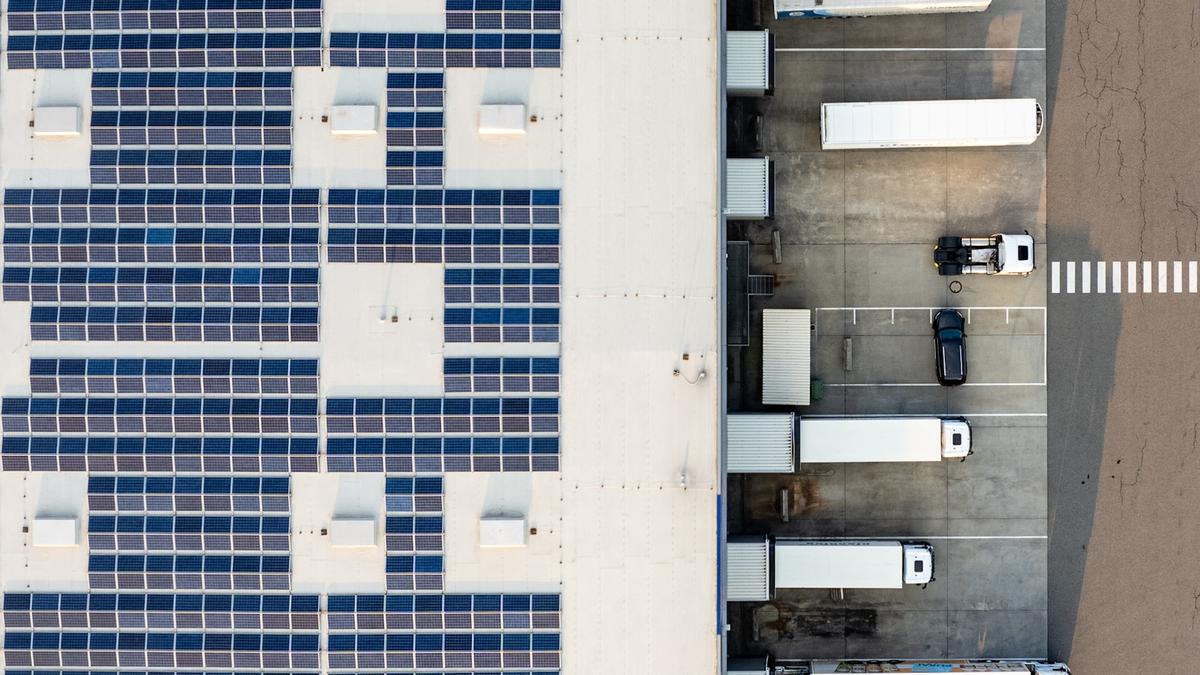
In ten years, photovoltaic panels have become the cheapest source of electricity ever deployed at scale. For an industrial, tertiary or logistics site, the question is no longer should we install solar — it is which technology, at what price, and how to maximise self-consumption.
This guide unpacks the technologies, the 2026 prices and the decision criteria for a B2B project.
How does a photovoltaic panel turn light into electricity?
A photovoltaic (PV) panel directly converts photons from solar radiation into DC electricity through the photoelectric effect discovered by Becquerel in 1839 and theorised by Einstein in 1905 (Nobel Prize, 1921).
The active material is silicon, the second-most abundant element in Earth's crust — but it has to be refined to over 99.9999 % purity to be usable. That metallurgical step remains the most energy-intensive and the most geographically concentrated (China leads).
The DC current produced is then converted to AC compatible with the grid by an inverter. On a project including a BESS, a hybrid inverter is used — one device that manages panels, battery and grid together.
Not to be confused with solar thermal panels (which heat a carrier fluid, no electricity produced) and concentrated solar power (CSP, mirrors focusing light onto a boiler — almost non-existent in Europe).
Monocrystalline, polycrystalline, emerging tech: what to choose in 2026?
Three families dominate the professional market in 2026:
- Monocrystalline PERC / TOPCon — the reference for any new installation. Efficiency 20-23 %. Better high-temperature tolerance. The standard on industrial rooftops since 2023.
- Heterojunction (HJT) — premium technology, efficiency 22-24 %, better performance under heat, but 10-15 % more expensive. Relevant for high-irradiance sites or where roof area is limited.
- Polycrystalline — being phased out on new installs. Efficiency 15-17 %. Only worth considering for second-hand or partial retrofits.
Tandem perovskite-silicon cells have entered serial production since 2025 with record efficiencies (> 30 % in the lab, ~ 27 % at module level), but commercial availability remains limited. Worth watching for 2027-2028.
How is the power of a panel measured?
The standard unit is the watt peak (Wp) — the power produced under Standard Test Conditions (STC): irradiance 1,000 W/m², cell temperature 25 °C, air mass AM 1.5.
A typical residential panel in 2026 outputs 420 to 460 Wp (in a 2 m × 1 m format). Modules for large industrial roofs exceed 600 Wp (in a 2.4 m × 1.2 m format).
The surface efficiency (η) is the ratio between peak power and solar power received per square metre. Example: a 450 Wp panel on 2.0 m² = 225 W/m² = 22.5 % efficiency. This metric determines how many Wp you can install per square metre of available roof.
What does a photovoltaic panel cost in 2026?
The PV market has gone through a historic price collapse: the factory-gate price in China has fallen from 0.30 €/Wp in 2020 to 0.08-0.12 €/Wp in 2025 (IEA, Renewables 2025). That fall has not been fully passed downstream — but the overall cost of a PV plant keeps coming down.
Indicative price range for a French installation in 2026:
- Industrial roof 100-500 kWp — 0.80 to 1.10 €/Wp installed turnkey (panels + inverter + structure + grid connection + commissioning).
- Ground-mounted plant 500 kWp to 5 MWp — 0.60 to 0.85 €/Wp installed.
- Carport canopy — 1.10 to 1.40 €/Wp installed (structure adds cost).
LCOE (levelised cost of PV electricity) over 25 years in France lands at 45 to 65 €/MWh in 2026 depending on the self-consumption rate — well below the French regulated blue-pro tariff (~ 180 €/MWh).
On 2026 incentives: self-consumption bonus for installations < 100 kWp, 10 % VAT on installations < 9 kWp (capped scheme), open-window feed-in tariff for surplus sales < 500 kWp. Installations > 500 kWp go through CRE auctions.
Pros and cons of PV for a B2B site
Concrete benefits:
- Zero marginal cost — once installed, every self-consumed kWh displaces 1 kWh bought from the grid (immediate saving).
- Contractual durability — 12-15 year product warranty, 80 % output guaranteed at 25 years (TOPCon, 2026).
- Minimal maintenance — no moving parts. Annual cleaning, thermographic check every 3-5 years.
- RSE / CSRD reporting — local decarbonised production usable in extra-financial reporting.
Structural limitations:
- Intermittency — no output at night, reduced output in winter. Coupling with storage smooths this.
- Inverse profile to some load curves — a tertiary site with summer cooling has excellent PV/load overlap. A 24/7 logistics site has poorer overlap — exactly where storage helps.
- Grid-connection constraints — above 250 kVA, the connection upgrade can represent 10-20 % of the total project budget.
- Roof area — about 6-8 m² of roof per kWp installed (TOPCon, 2026).
How to overcome the limits of PV alone? The BESS coupling
A PV site without storage typically exports 30 to 50 % of its output back to the grid (valued 2-3× lower than the purchase price). Adding a BESS captures that energy and feeds it back at peak.
On a typical industrial site in 2026, coupling 300 kWp of PV with a 200 kWh BESS raises the self-consumption rate from ~ 55 % to ~ 85 % and shortens the project ROI from 9-10 years to 6-7 years. See our case studies for costed examples.
To assess this sizing on your site, see our load curve analysis guide.
Frequently asked questions
How many panels does an SME need?
It depends on annual consumption and the self-consumption target. Reference: an SME consuming 200 MWh/year and aiming for 50 % self-consumption needs about 200-250 kWp installed, or 400-500 panels of 450 Wp.
What is the real output of a panel in Southern France vs Northern France?
The gap is around 25-30 %. Marseille yields ~ 1,350 kWh/kWp/year, Lille ~ 950 kWh/kWp/year. PV remains largely profitable in the north, but ROI is faster in the south.
Is a feasibility study mandatory before installation?
Yes, always. The study covers roof structure (load capacity), shading masks, load-curve analysis, grid impact study, financial simulation. Plan 5-15 days for an SME, 3-6 weeks for a complex industrial site.
What is the lifetime of a solar panel?
25 to 30 years in service, with an average degradation rate of 0.4 to 0.5 % per year for TOPCon panels (2026). At 25 years, a panel still delivers 80-85 % of its original output.
What happens to a panel at end of life?
An organised recycling channel exists in France through Soren (PV eco-organisation). Material recovery rate > 90 % in 2026 (glass, aluminium, silicon, metals).