
End of feed-in tariff: what to do with your solar plant?
France's first 2006 solar feed-in contracts have been expiring since July 2026. Market sales, PPA or self-consumption with a battery: what to do with your solar plant?
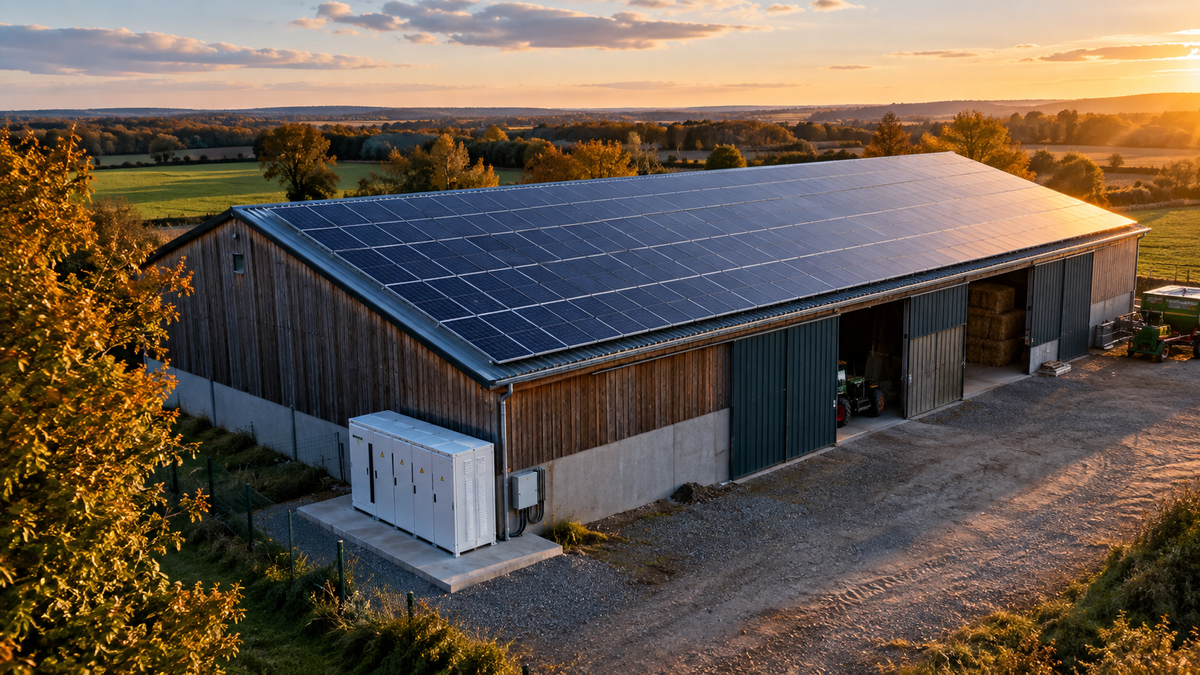
The end of feed-in tariff contracts has begun for France's first solar plants. Since 26 July 2026, contracts signed under the 2006 tariff order have been reaching the end of their 20-year term (Hespul, 2026). About 235,000 contracts were signed between 2006 and 2010, for 3.6 GW (CRE).
At expiry, no support scheme takes over. The plant keeps producing, but its electricity is only worth its market price. The owner can sell on the market, sign a PPA or self-consume. In most cases, the right answer combines these options.
What happens when a feed-in tariff contract ends?
The end of a feed-in tariff contract stops the purchase of electricity at a guaranteed price. EDF OA, the designated purchaser, removes the installation from its balancing perimeter. Enedis, the distribution network operator, then asks the producer to appoint a new balancing party, which is required to keep the grid access contract (photovoltaique.info, September 2026, in French).
- No extension: the contract with the designated purchaser cannot be extended.
- No new support: no public scheme is planned after the 20 years.
- No automatic purchase: without a new buyer, exported electricity is no longer paid for and grid access can be terminated.
- No penalty: the termination fee only applies to early exits, not to the natural end of the contract.
The 20-year term runs from commissioning, not from signature. That date appears on the contract: it is the first thing to check.
How many contracts are expiring, and when?
The contracts concerned fall under the tariff orders of 2006 and of January and August 2010, known as S06, S10 and S10B. The S06 order guaranteed €300/MWh for ground-mounted plants, €400/MWh on buildings and €550/MWh for building-integrated systems (CRE). These levels favoured farm and industrial rooftops selling their entire output.
Expiry dates are spread over several years. Many plants authorised in 2010 were commissioned later. According to the CRE (deliberation no. 2026-149) (in French), most of these contracts will expire before 2033, with a decline starting in 2029.
These contracts still cost nearly €2 billion a year in public service charges (CRE, July 2026). The draft 2027 finance bill plans to terminate early those above 250 kWp, on dates set by ministerial order (article 82).
This text, not adopted as of 16 October 2026, would only affect about a thousand large plants. All others keep their contractual schedule.
What is solar electricity worth after the end of the feed-in tariff?
Outside a feed-in tariff, a solar kWh sold is worth the market price at the hours it is produced. That price is falling, because all solar plants produce at the same hours.
- Average spot price: €61/MWh in 2025 (RTE, Electricity Report 2025).
- Solar capture price: €40/MWh in 2025, or 66% of the average spot price (CRE, 2026).
- Market value of self-consumption surplus: about €20/MWh in 2025 (CRE, deliberation no. 2026-92).
- Negative prices: 513 hours in 2025, then 407 hours in the first half of 2026 alone (RTE).
For a building-integrated S06 plant, revenue per MWh is therefore divided by more than ten. A 100 kWp installation producing 110 MWh a year goes from about €60k at its original tariff to €4.4k at the 2025 capture price (Battwoo calculation, excluding indexation). Our articles on solar resale in France and negative electricity prices explain this trend.
The installation remains productive: solar modules last more than 30 years (photovoltaique.info).
What are the options after the end of the feed-in tariff?
After the end of the feed-in tariff, the owner can sell the electricity or consume it. Dismantling remains possible, but it deprives the site of a plant that still produces. The right choice depends on the site's consumption and grid connection.
Selling on the market through an aggregator
An aggregator buys the output and takes on balancing responsibility. Offers differ in set-up fees, monthly fees, commitment period and price revision (photovoltaique.info, 2026).
The price follows the midday market, around €40/MWh in 2025, minus fees. Bidders in France's small-solar tender declare aggregation fees of about €5/MWh (CRE, 2026).
Signing a PPA
A PPA (power purchase agreement, a direct supply contract) sells the output to a consumer at a price fixed for several years. It provides visibility, but the buyer prices in the solar profile risk.
For a 100 to 250 kWp plant, volumes remain small compared with the cost of structuring a bilateral contract.
Switching to self-consumption
Self-consumption means using the electricity produced on site before exporting any surplus. For a plant that sells its entire output, the switch takes three steps (photovoltaique.info, 2026):
- Ask Enedis to change the operating mode from full export to surplus export.
- Remove the production meter, which is no longer needed.
- Connect the plant to the site's main low-voltage switchboard, through an electrician.
The cost of the switch and the electrical compliance rules are still to be clarified (photovoltaique.info, 2026).
The economic case is clear. Under the regulated Bleu Pro tariff, a kWh on the Base option costs 16.24 c€ excluding VAT since 1 August 2026 (CRE, deliberation no. 2026-147). Each self-consumed MWh therefore avoids about €160 of purchases, versus €40 if sold at the capture price.
Why add a battery to a plant at the end of its feed-in tariff?
A battery lets the site consume a larger share of its solar output, within the limits of its own needs. Without storage, most midday output goes to the grid.
A BESS (Battery Energy Storage System, a stationary battery installation) charges with this midday surplus. It releases it late in the day, when the site consumes without sun. This is the principle of enhanced solar self-consumption.
- Enhanced self-consumption: a stored and consumed MWh avoids a grid purchase, instead of selling for about €20–40/MWh.
- Peak/off-peak time-of-use shifting: the battery charges during cheap hours and powers the site during expensive ones.
- Daily price spread: €111.3/MWh on average in the first half of 2026 between the most and least expensive hours (RTE).
The TURPE (France's public electricity network tariff) adds to this. From April to October, the preferred off-peak windows now include 11:00–17:00 (CRE, deliberation no. 2026-33). A midday solar kWh then replaces a kWh bought at the day's lowest price.
Battwoo systems start at 100 kWh and discharge in three hours (C/3). Battwoo's BMS (battery management system) measures the SoH (state of health) of every cell. A second-life battery reuses electric vehicle modules, with a lower installed cost per kWh than new.
What if the site consumes less than the plant produces?
This is the most common case: these rooftops were sized to sell their entire output, well beyond the site's needs. A battery alone does not fix this imbalance: it shifts energy within the day, it does not create demand.
The key indicator is the coverage rate: the share of output the site can consume, directly or through storage. When it is low, the solution combines several levers:
- Collective self-consumption: selling the surplus to nearby consumers, such as a neighbouring farm, a cooperative or a municipality.
- Loads moved to midday: irrigation, drying, refrigeration, ventilation or vehicle charging, scheduled during production hours.
- A battery sized on the site: its capacity follows evening consumption, not the plant's output.
- Time-shifted sales: the battery charges with midday surplus and exports it in the evening, when market prices are higher.
- Sale of the remainder through an aggregator, without exporting during negative prices.
Collective self-consumption is often the most profitable lever for the surplus. The perimeter is 2 km, extended to 20 km in rural areas, for up to 5 MW (ECOinfos, September 2026). The price is negotiated between the market price, around €40/MWh, and what the neighbour pays its supplier.
Since a Conseil d'État ruling of 30 March 2026, the share consumed locally is exempt from electricity excise duty, for installations below 1 MWp.
Time-shifted sales have limits. A 100 kWh battery cycling once a day shifts about 28 MWh a year. With an effective spread of €90/MWh, the gain is around €2.5k a year (Battwoo calculation). It complements self-consumption without replacing it.
Battwoo benchmarks, by share of output the site can consume:
- Above 40%: self-consumption and a battery form the core of the project.
- Between 15% and 40%: a battery sized on the site, collective self-consumption for the surplus, sale of the rest.
- Below 15%: collective self-consumption or an aggregator first; the battery comes second.
How do you choose the right option for your plant?
The choice is based on the site's actual consumption and the plant's output, never on a single purchase offer.
- Check the commissioning date on the contract to know the exact expiry.
- Have the installation inspected: modules, inverter, wiring and roof waterproofing.
- Analyse the site's load curve at 10- or 30-minute intervals, over at least twelve months.
- Rebuild the plant's hourly output, including module ageing.
- Compare the value of each MWh: market price net of fees, sale to a neighbour, avoided purchase price, battery gain.
- Start the Enedis procedures several months before expiry.
This is the approach behind our sizing study: the right battery size depends on your data, not on a standard ratio. To assess your plant's options before it expires, request a study.
End of feed-in tariff: key takeaways
- 235,000 contracts signed between 2006 and 2010, for 3.6 GW (CRE).
- Expiries since 26 July 2026, mostly before 2033 (CRE).
- No extension and no public support after 20 years.
- A capture price of €40/MWh in 2025 for solar sold on the market (CRE).
- A self-consumed kWh avoids a grid purchase about four times more expensive.
- A low-consumption site combines self-consumption, local sharing and sale of the rest.
- A battery sized on evening consumption, not on the plant's output.
Sources
- photovoltaique.info — End of feed-in tariff contracts (in French) — procedures and options at contract end, September 2026.
- CRE — Deliberation no. 2026-149 on public service charges 2026–2027 (in French) — cost and schedule of pre-2011 contracts, July 2026.
- CRE — Note on solar coupled with storage (in French) — solar capture price in 2025, March 2026.
- CRE — Deliberation no. 2026-92 (opinion on the S21 Order) (in French) — market value of surplus, April 2026.
- CRE — Deliberation no. 2026-33 (TURPE 7) (in French) — midday off-peak hours, February 2026.
- CRE — Deliberation no. 2021-160 (revision of S06 and S10 contracts) (in French) — number of contracts and historical tariffs, July 2021.
- RTE — 2025 Electricity Report, Prices chapter — average spot price and negative price hours, 2026.
- RTE — First-half 2026 report (in French) — negative prices and daily price spread, July 2026.
- Hespul — 20 years since the S06 tariff order (in French) — first expiries on 26 July 2026, July 2026.
- L'Echo du Solaire — 2027 budget and 2006–2010 contracts (in French) — article 82 of the draft finance bill, October 2026.
- ECOinfos — Electricity shared between neighbours (in French) — collective self-consumption rules, September 2026.
- Selectra — Regulated business tariffs on 1 August 2026 (in French) — Bleu Pro tariff, based on CRE deliberation no. 2026-147, August 2026.
FAQ on the end of feed-in tariffs
Can a feed-in tariff contract be extended after 20 years?
No. The contract with the designated purchaser cannot be extended, and no public support is planned after the 20 years (photovoltaique.info, 2026). The producer must find a new buyer, self-consume or dismantle.
What happens if you do nothing at expiry?
Exported electricity is no longer purchased. Without an appointed balancing party, Enedis can suspend and then terminate the grid access contract. The panels keep producing, but that output no longer earns anything.
Is a new Consuel certificate needed to switch to self-consumption?
The compliance rules for the switch are still to be clarified as of 16 October 2026 (photovoltaique.info). Consuel is France's electrical safety certification body. Hespul submitted proposed technical rules to Consuel and Enedis (July 2026).
Are plants above 250 kWp affected by the 2027 budget?
The draft 2027 finance bill plans to terminate S06, S10 and S10B contracts above 250 kWp early. Dates would be set by ministerial order, with a safeguard clause. As of 16 October 2026, the text is being debated in Parliament.
What if the site consumes much less than the plant produces?
A battery is not enough: it shifts energy, it does not create demand. The surplus is first best valued through collective self-consumption, with neighbours within 2 km, or 20 km in rural areas. The battery is sized on the site's needs, and the remainder is sold through an aggregator.