
Sizing study: an essential first step before comparing any price per kWh
Before comparing prices per kWh, a sizing study determines whether battery storage is profitable for your site. Method and key indicators explained.
Why price per kWh is not enough to decide
The price per kWh of a battery storage system is a useful criterion, but it isn't the first one. Before any price comparison, a sizing study determines whether installing a battery is genuinely relevant for your site. It is this study that determines the project's profitability.
As we discussed in what a battery storage quote actually covers, price matters — but making it the sole decision criterion would be reductive.
Price per kWh has one merit: it puts offers from several suppliers on a common basis. But it still requires comparing correctly sized installations. An oversized battery inflates the investment without a proportional gain; an undersized battery leaves savings on the table.
Market conditions reinforce this point. The average price of a stationary battery energy storage system (BESS) fell 31% in one year, to around $117/kWh in 2025 (BloombergNEF, Energy Storage Systems Cost Survey 2025). Falling prices make the economic case more accessible, but they don't remove the need to verify that the site has a real need to cover.
What is a battery sizing study?
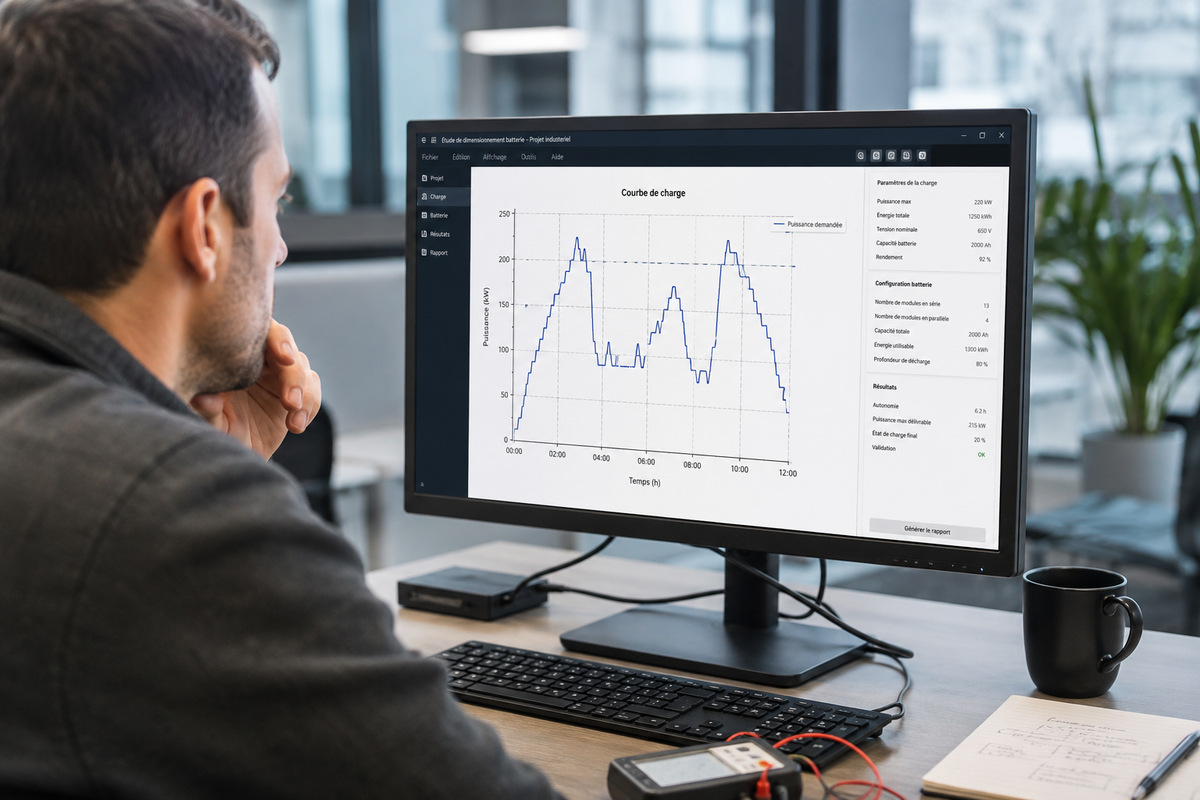
A sizing study is the preliminary analysis that evaluates a storage project as a whole and objectifies its profitability, based on the site's actual consumption profile. It defines the useful power and capacity, then quantifies the expected gains. At Battwoo, no commercial proposal is issued without this study, which is presented to the client in a detailed report.
This step is often overlooked, for a simple reason: it isn't always the core business of installers or battery manufacturers. Only specialized engineering firms systematically deliver a detailed analysis of a battery's relevance in light of the load curve.
What indicators should a sizing study provide?
A usable study isn't limited to a power and a capacity figure. It quantifies the indicators needed to make the decision objective:
- The power (kW) and capacity (kWh) of the battery, matched to the site's profile
- The annual savings achieved on the electricity bill
- The self-consumption rate (SCR) of the solar installation — the share of PV production consumed on site
- The self-sufficiency rate (SSR) — the share of the site's consumption covered by its own production
- The amount of energy stored in the battery each month
- The cost of the installation service
- The return on investment (ROI) and, ideally, the LCOS (levelized cost of storage over the system's lifetime)
The LCOS (Levelized Cost Of Storage) relates the system's total cost, over its entire cycled lifetime, to each kWh delivered. It's the indicator that allows two offers to be compared beyond the sticker price, because it factors in efficiency, lifespan, and cycles. At utility scale, it stood at around $65/MWh in October 2025 (Ember, 2026); for an industrial or commercial site, the value depends closely on the sizing and usage profile.
How does a sizing study work?
The process follows a step-by-step logic, from recording consumption to the economic assessment.
- Analysis of the site's load curve (power drawn, hour by hour)
- Identification of relevant use cases: self-consumption, peak shaving, off-peak/peak shifting, arbitrage, flexibility
- Simulation of battery operation on the actual profile, with several power and capacity scenarios
- Quantification of annual savings, ROI, and LCOS for each scenario
- Detailed presentation and selection of the optimal sizing with the client
Off-peak/peak shifting involves charging the battery when electricity is cheapest and discharging it during costly hours. In 2025, the average daily gap between the minimum and maximum price on the French spot market reached a record 95 €/MWh, up 27% year-on-year (Observatoire des prix, 2025). This growing gap is precisely what makes arbitrage and shifting worthwhile — provided the sizing matches the consumption profile.
Engineering firm, manufacturer, and installer: why the role matters
The quality of a sizing study depends on mastering the entire value chain. At Battwoo, three areas of expertise are combined: engineering firm, battery manufacturer, and installer. This integration makes it possible to master the technical and economic subtleties of the project, from diagnosis through to commissioning.
Battwoo systems are built on second-life electric vehicle battery modules, managed by a proprietary BMS (Battery Management System) that performs a cell-by-cell state-of-health diagnosis (SoH, State of Health). Reusing EV modules reduces the carbon footprint compared with new cells and delivers a competitive cost per installed kWh for stationary use.
What data should be gathered before a sizing study?
The accuracy of a sizing study depends directly on the quality of the data provided upfront. The more thoroughly the site's consumption profile is documented, the more the simulation reflects how the battery will actually perform. Here are the elements to gather before starting the analysis:
- The site's load curve, ideally at the finest time resolution available (10 minutes or hourly), over at least twelve months to capture seasonal variations
- Recent electricity bills, which show the subscribed power, the tariff option, and the peak/off-peak structure
- The characteristics of any existing solar installation: peak power, orientation, measured annual output
- Planned site developments: new equipment, EV chargers, business expansion, which change the future load curve
- Any power constraints already encountered: exceeding subscribed power, billed penalties
This data makes it possible to calibrate power and capacity scenarios as close to reality as possible. Conversely, a study based on generic averages or a single bill produces an approximate sizing, whose estimated gains often diverge from the results observed in operation.
Frequently asked questions
How much does a battery sizing study cost?
The cost varies depending on the site's complexity and the level of detail expected. At Battwoo, the study systematically precedes any commercial proposal and is presented in a detailed report. The best approach is to discuss the terms during an initial conversation.
What's the difference between a battery's power (kW) and capacity (kWh)?
Power (kW) measures the instantaneous rate at which the battery can deliver or absorb energy; capacity (kWh) measures the amount of energy stored. A site with short power peaks should prioritize power; a site looking to shift large volumes of energy should prioritize capacity. The sizing study balances the two.
Does a sizing study guarantee profitability?
It doesn't offer an automatic guarantee, but it makes the expected profitability objective, based on real data rather than generic assumptions. It can also conclude that a battery isn't relevant for a given site, which is useful information before any investment.
Is price per kWh still a valid criterion?
Yes, but as a second step. It allows offers to be compared once the sizing has been established. Comparing price per kWh between installations of different sizes doesn't make sense: it's the LCOS and ROI based on the site's actual profile that truly distinguish between proposals.
How long does a sizing study take?
The timeline depends on the availability of the site's consumption data (load curve, bills, any existing solar production). The more complete this data is, the more accurate and quick the simulation will be to produce.