
Solar panel orientation and tilt: maximise PV output
Orientation, tilt, shading: three levers that change photovoltaic output by 30 % or more with the same hardware. Complete method for a B2B project.
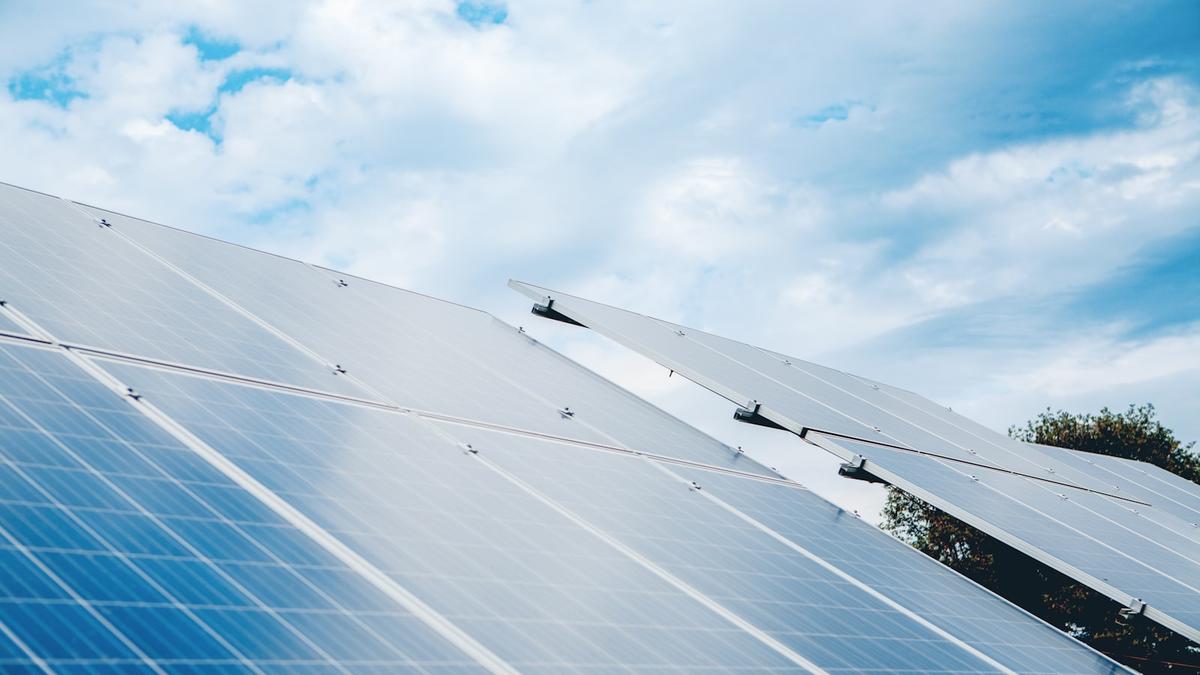
With strictly identical hardware, two PV installations can produce 30 % more or less energy depending on their orientation, tilt and exposure to shadows. For a B2B project where every self-consumed kWh displaces a grid purchase, that gap changes the project ROI.
Here are the three levers to master before freezing a layout.
Why do orientation and tilt drive PV output?
A photovoltaic panel produces maximum energy when the sun's rays strike it at 90° (perpendicular). The further the angle of incidence drifts from perpendicular, the smaller the share of energy absorbed — and the larger the share reflected.
Because the sun travels across the sky over the day and across the seasons, a fixed panel can only be perpendicular at a single instant. Choosing orientation + tilt therefore comes down to maximising the annual average of that angle of incidence.
What is the best orientation for panels in Europe?
In the Northern hemisphere, the sun peaks due south at solar noon (12:00 GMT in winter, 13:00 in summer time). For a fixed installation, due-South orientation therefore maximises annual output.
- South — reference, 100 % output. Bell-shaped daily profile centred on noon.
- South-East / South-West (± 45° from South) — about 5 % loss vs South. Peak shifted to morning or afternoon.
- East / West — about 15-20 % loss. But spreads production over the day — relevant if consumption is bimodal (morning + late afternoon).
- North — 40-50 % loss. To avoid unless forced.
For a B2B site with a flat daytime consumption profile (offices, workshops 8 am-6 pm), an East+West dual exposure can produce more self-consumed energy than a South exposure — because output stays high for longer in the day, better matched to load.
What tilt should you choose by latitude?
The tilt (angle between the panel and the horizontal) that maximises annual output is approximately equal to the latitude of the site.
Reference points in metropolitan France:
- Lille (50.6° N) — optimum tilt ~ 35-40°.
- Paris (48.9° N) — optimum tilt ~ 35°.
- Lyon (45.8° N) — optimum tilt ~ 33°.
- Marseille (43.3° N) — optimum tilt ~ 30°.
On flat or low-slope industrial roofs (< 15°), the latitude rule is usually not respected — installing on 30-40° racks would create back-shading between rows that lowers the kWp density per m².
The standard B2B trade-off: 10-15° tilt (close to natural roof slope), 5-7 % annual loss vs the optimum tilt, but 30-40 % more kWp installed at equal roof area. Net annual output is well in the positive.
For ground-mounted plants and carports, optimum tilt (close to latitude) remains the rule.
Shading and solar masks: how to detect and manage them
Partial shading does not reduce output proportionally to the shaded area — it can kill the output of an entire string if panels are wired in classical series. That is the hotspot effect, driven by the weakest cell in the string.
Three types of solar masks to identify upfront:
- Far masks — terrain, buildings over 500 m away. Small effect, but worth including in the simulation.
- Near masks — trees, neighbouring buildings, chimneys, antennas. Major effect, to be modelled hourly.
- Self-shading — panels shading each other when the sun is low. Driven by row pitch.
Free tools to model shadows: PVGIS from the European Commission (handles far masks), SunEarthTools (solar trajectory at the install point). For near masks, a 3D survey (drone or CAD software) is essential on any project above 100 kWp.
Technical mitigations for partial shading:
- Micro-inverters — one inverter per panel, full isolation of a shaded panel. Cost premium ~ 15-20 %.
- Power optimisers — per-panel MPPT with a central inverter. A middle-ground option.
- Smart string layout — group panels by similar shading zones.
How much output spread between an ideal and a sub-optimal install?
Summary for a typical French site (reference Lyon, 1,200 kWh/kWp/year at optimum):
- South orientation, 30° tilt, no shading: 100 % reference
- South-East orientation, 15° tilt (industrial roof): 88-92 %
- East-West split, 10° tilt: 80-85 %
- Morning partial shading 1 h/day (no optimiser): −10 to −15 %
- Sub-optimal combo + untreated shading: 65-75 %
A rigorous upfront study — load curve + PVGIS simulation + mask survey — systematically targets the top of that range.
Frequently asked questions
Should I install solar trackers?
On a ground-mounted plant above 1 MWp with sufficient land, a single-axis tracker adds 15-25 % annual output for a 10-15 % cost premium. On a rooftop, never — the mechanics are incompatible with a standard load capacity.
My roof faces East-West. Is it still worth it?
Yes, in most cases. The annual loss is 15-20 % vs South, but the production profile spread across the day often improves the self-consumption rate — so real economic returns are close, sometimes higher for certain B2B profiles.
How to optimise an existing installation?
Three levers: (1) couple with a BESS to capture surplus, (2) install micro-inverters or optimisers if shading is partial and known, (3) annual cleaning and inspection (a dirty panel loses 5-15 % of output).
Does the optimum tilt change if I prioritise self-consumption over annual output?
Yes. To maximise B2B self-consumption, panels are often tilted less (10-20°) to better capture during midday peak hours and spread the production. To maximise annual energy sold to the grid, follow the latitude rule.
Do I need to redo the orientation study when adding a BESS later?
Not the PV study itself, but yes the overall strategy: with a BESS, you can afford to over-produce at midday (stored for the evening) — which allows more optimum tilts for annual output without hurting self-consumption.