
Refrigerated warehouse solar: matching output to cold load
A cold store runs around the clock; a rooftop array runs six hours. How to close the gap: self-consumption limits, pre-cooling, and second-life battery storage.
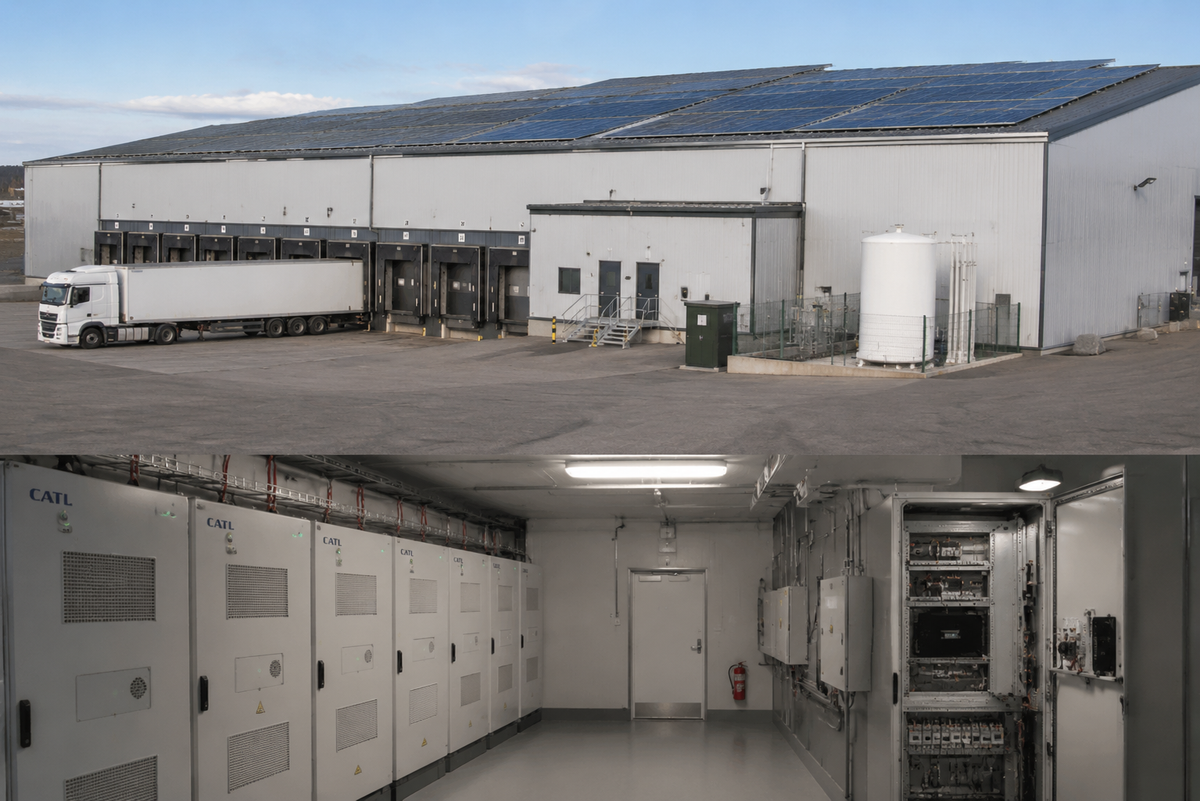
A refrigerated warehouse runs 24 hours a day; a rooftop array produces for four to six useful hours. Matching the two curves means closing three gaps — night, winter, and short compressor peaks. Electrical storage is what bridges them without touching the cold chain itself.
The economics shifted in 2025. Across Europe, wholesale prices went below zero more often than in any previous year: Sweden's SE2 zone recorded 593 hours, the Netherlands 584, Germany 576, Spain 569 and France 513 (Bloomberg, January 2026). For any cold storage solar project, that changes the question. Exported surplus is no longer the fallback it was — what counts is how much of the array's output the site absorbs on the spot.
Why is refrigeration such a large electricity load?
Refrigeration is a continuous load because it works against a permanent heat gain: conduction through insulated panels, air infiltration at every door opening, heat from forklifts, lighting and incoming product. Compressors never stop for long, including at night and on non-operating days.
Globally, refrigeration accounts for 20 % of electricity consumption and 7.5 % of CO2 emissions (International Institute of Refrigeration, technical brief 2025, 3rd edition). Income-driven cooling demand alone is expected to add roughly 330 GW to global peak electricity demand by 2035, with higher temperatures adding a further 170 GW (IEA, World Energy Outlook 2025).
Three features separate this load profile from a dry warehouse:
- A high baseload floor. Consumption never reaches zero, even when the site is closed.
- Summer-weighted seasonality. Demand peaks when ambient temperatures widen the differential the plant must hold.
- Short, steep power peaks. Compressor starts, defrost cycles and restarts after an outage draw far above average site load.
Does a cold store's load curve match solar output?
Better than most commercial buildings, but not completely. Cooling demand rises with outdoor temperature, so it peaks on summer afternoons — precisely when photovoltaic output is highest. That natural correlation is the strongest argument for putting solar on a refrigerated site rather than a dry one.
Three gaps remain. At night, the cooling load stays high while generation is zero. In winter, output collapses while the load barely moves. And compressor inrush peaks do not politely wait for midday sun.
The same mismatch is now visible at market level. Rising solar penetration is deepening the duck curve, widening the gap between a depressed midday block and expensive morning and evening hours, which the European regulator flags as a growing driver of demand response and storage needs (ACER, Market Monitoring Report 2026). A site that can move energy across those hours captures value that a generation-only project structurally cannot.
How much of a cold storage solar array can the site absorb?
A refrigerated site reaches a higher self-consumption rate than an office building, but it plateaus as soon as installed photovoltaic capacity exceeds the daytime load floor. Every kilowatt-hour beyond that point goes to the grid — increasingly at a price that no longer justifies the capital behind it.
That plateau is the practical design constraint on any cold storage solar project. Sizing the array on average annual consumption under-produces in winter and exports at a loss in summer. Sizing it on the summer peak makes the export problem worse without improving winter cover. Neither variant is solved by adding modules.
Storage moves the plateau rather than raising the array. It absorbs the midday block, releases it into the night-time cooling load, and leaves the refrigeration plant running at constant setpoint throughout. The cold chain sees no change; the meter does.
Can you shift the cooling instead of storing the electricity?
Yes, within a narrow band. Pre-cooling means driving the chamber below setpoint during solar hours, then letting compressors idle when power is expensive. The thermal mass of stored product acts as the reserve. It works, and it costs nothing in capital.
The limit is regulatory before it is technical. For frozen foodstuffs, Regulation (EC) No 853/2004 requires a storage temperature at or below −18 °C. The +3 °C tolerance frequently cited applies only to physical transfer at delivery, not to permanent storage. The manoeuvring band is therefore one-directional: a cold store can go colder, never warmer.
A thermodynamic penalty comes with it. Cooling below setpoint degrades the plant's coefficient of performance, so energy banked as cold costs more to produce than energy consumed at nominal setpoint. Thermal shifting remains a legitimate first move — it does not substitute for electrical storage capacity.
What does a second-life BESS add to a refrigerated site?
A BESS — a stationary battery energy storage system — decouples generation from consumption without any change to the refrigeration process. It absorbs midday surplus, discharges into night-time load and peak windows, and leaves product temperature untouched. No trade-off against food safety.
The cost case turned decisively in 2025. The benchmark levelised cost of electricity for a standalone four-hour battery project fell 27 % to $78/MWh, the lowest since tracking began in 2009, while 87 GW of co-located solar-plus-storage was added worldwide at an average $57/MWh (BloombergNEF, Levelized Cost of Electricity 2026, February 2026).
Second-life systems add two further levers. Installed cost per kilowatt-hour sits below new cells at equivalent performance over the stationary duty window, and the embedded carbon is lower because cell manufacturing has already been amortised across a first automotive life.
Does the EU Battery Regulation affect second-life storage projects?
It raises the traceability bar, and second-life systems are well placed to meet it. Under Regulation (EU) 2023/1542, carbon footprint declarations for rechargeable industrial batteries above 2 kWh applied from February 2026, ahead of performance classes and the digital battery passport scheduled for 2027.
The practical effect is that a storage asset now has to be documented, not merely delivered. Cell provenance, state of health at commissioning and expected cycle life become part of the procurement file — which is where measurement separates a credible second-life supplier from a broker of untested modules.
Battwoo grades every incoming module before assembly. The BMS (battery management system) diagnoses SoH — state of health, as a percentage of original capacity — cell by cell, then monitors voltage, temperature and capacity drift in operation. Contractual performance is expressed in delivered capacity over an agreed cycle count, not calendar years. See our engineering page.
How does peak shaving cut a cold store's network costs?
Peak shaving is the practice of capping the power a site draws from the grid by supplying the shortfall from a battery. On a refrigerated site it targets simultaneous compressor starts and restarts after defrost — events lasting minutes that can set a billed capacity level for a full year.
Across Western European markets, network charges are built on subscribed or measured capacity, and they are rising as grid operators fund reinforcement for electrification. Each kilowatt of avoided peak therefore produces a recurring saving that grows with the tariff, independently of the energy price.
Time-based shifting is the second lever. Charging on off-peak hours and on solar surplus, then discharging into peak windows, suits a refrigerated load profile particularly well because night-time consumption is already substantial. The two functions share the same asset — sizing decides how the capacity is split between them.
Which flexibility revenues are open to cold storage in Europe?
A battery installed for self-consumption sits idle much of the year. That residual capacity can be offered to system operators without compromising its primary duty, provided the control logic reserves a guaranteed floor for refrigeration continuity.
Four routes exist in most Western European markets:
- Balancing markets. Transmission operators pay for capacity mobilisable in real time to keep the system in equilibrium.
- Capacity mechanisms. Several member states remunerate firm capacity available during system stress periods, with designs currently under reform.
- Explicit demand response. Aggregated load reduction sold day-ahead or intraday, under national implementations of EU rules.
- Day-ahead arbitrage. Buying into the midday trough and discharging into the evening peak — a spread solar growth keeps widening.
These streams change payback arithmetic rather than decorating it. Modelling them at design stage separates a project sized for self-consumption alone from one sized to earn across several markets. Our use-case page sets out each configuration.
How do you size solar and storage for a refrigerated warehouse?
Sizing starts from a measured load curve, never a generic ratio per square metre. A frozen-goods warehouse, a chilled fruit-and-vegetable platform and a processing site with a blast freezer produce three different profiles at comparable floor areas.
The working sequence:
- Record the load curve at 10-minute resolution over 12 months. Compressor peaks are invisible on a monthly invoice.
- Identify the daytime load floor. It sets the photovoltaic capacity absorbable without storage.
- Measure the gap between billed capacity and average draw. That gap is the peak shaving prize.
- Size energy and power separately. Peak capping needs power; night-time shifting needs energy.
- Check the LCOS — levelised cost of storage across the cycled lifetime — against the spread the site can actually arbitrage.
- Put the cooling constraint first. Setpoint continuity outranks optimisation, without exception.
[À VÉRIFIER : donnée terrain Battwoo à insérer ici — écrêtement mesuré ou économie annuelle constatée sur un site frigorifique équipé. Rédiger une formulation propre à l'anglais, pas une traduction de la phrase FR.]
Worked examples sit in our case studies. A preliminary assessment runs on three inputs: annual load curve, billed capacity, current supply contract. Send them over and we will size the envelope.
Frequently asked questions
Can a battery act as backup for a cold store during a grid outage?
Yes, provided the installation is designed for islanded operation. A BESS with automatic transfer capability supplies priority compressors through an outage. Autonomy depends on installed capacity and on how many circuits are classified as critical, which is agreed with the operator at design stage.
Should the rooftop array be oversized once storage is added?
Not automatically. On a cold storage solar site, storage raises the share of generation consumed on site, which allows more capacity before exports begin. The optimum depends on the night-time load floor and the hourly price spread, so the calculation runs on the measured load curve rather than on available roof area.
Does electrical storage replace pre-cooling?
No — the two are complementary. Pre-cooling is free in capital but bounded by the −18 °C regulatory setpoint and penalised by degraded compressor efficiency. Electrical storage has no effect on product temperature and covers longer durations, including overnight and multi-hour peak windows.
Can second-life batteries operate in a refrigerated environment?
Storage cabinets are not installed inside the cold zone. They sit in a technical room or an outdoor container where the operating temperature range is controlled. Lithium-ion cells lose available power below 0 °C, so siting is a design decision rather than an installation detail.
How long does it take to assess a project on a refrigerated site?
A pre-qualification needs the annual load curve at 10-minute resolution, the billed capacity and the current supply contract. Those three inputs are enough to estimate the peak shaving saving and the absorbable solar share. Detailed sizing follows, based on a site survey.