
Photovoltaic Storage: CRE Reform Explained
France lost 1.6 TWh of solar power in 2025. The CRE reform accelerates PV + storage to boost flexibility, reduce losses, and improve profitability.

Photovoltaics with storage (BESS) is becoming the key response to negative electricity prices and grid congestion. In 2025, France curtailed 1.6 TWh of solar production due to negative market prices—around 20% of output under feed-in premium schemes (CRE 2026). The reform published on March 19, 2026 aims to fix this inefficiency by prioritizing flexibility and storage integration.
Why does photovoltaic energy lose value without storage?
Photovoltaic systems without storage inject large volumes of electricity at midday, when supply exceeds demand. This leads to price drops and curtailment.
The issue is not solar production itself, but its lack of controllability.
- Midday overproduction
- Negative spot prices
- Grid saturation
- No temporal shifting capability
What is changing with the 2026 CRE reform?
The CRE introduces new incentives to integrate BESS (Battery Energy Storage System, stationary energy storage system) into large solar installations.
- PV + storage hybridization: only 22 out of 1,470 recent projects include storage
- New M0 reference price: unweighted to reward valuable production hours
- Negative price premium reform: incentive to store instead of curtail
Why is storage becoming essential?
Stationary storage allows energy to be shifted from low-value to high-value periods. It improves both profitability and grid stability.
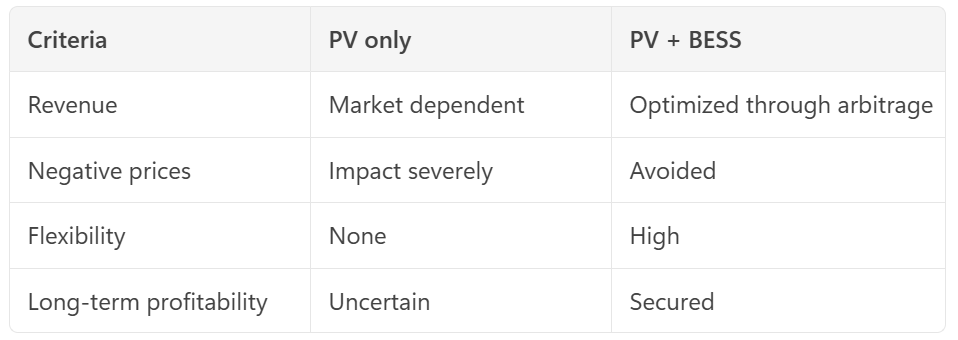
- Store midday production, inject in the evening
- Avoid negative prices
- Contribute to flexibility
- Generate revenue via arbitrage
PV vs PV + BESS: what are the economic differences?
How does a storage system operate in practice?
A system equipped with a BESS can be controlled using a BMS (Battery Management System, battery control system) and APIs.
- Cloud connection (e.g., Solis inverters)
- Data collection (production, pricing, SoC – State of Charge)
- Automated charge/discharge cycles
- Optimization via spot or intraday market strategies
What revenue streams does a BESS unlock?
Energy storage enables multiple revenue streams that can be combined.
- Autoconsommation
- Peak-shaving
- Off-peak / peak time use shifting
- Spot market arbitrage
- Participate in Grid flexibility markets
Some operators manage batteries via API and redistribute generated revenues to stakeholders on a monthly basis.
What is the role of Enedis and grid services?
Grid services require fast response capabilities and minimum discharge durations, typically between 1 and 2 hours depending on the mechanism. This favors properly sized BESS installations.
Why are second-life batteries relevant?
A second-life battery reuses electric vehicle batteries whose SoH (State of Health) remains high enough for stationary use.
- Lower cost than new batteries
- Reduced environmental impact
- Performance well suited for stationary applications
Sources
- CRE – « La CRE publie ses propositions pour optimiser le développement des grandes installations photovoltaïques » : https://www.cre.fr/actualites/toute-lactualite/la-cre-publie-ses-propositions-pour-optimiser-le-developpement-des-grandes-installations-photovoltaiques.html
- CRE - Développement des installations couplant solaire photovoltaïque de plus de 100 kWc et stockage stationnaire : https://www.cre.fr/fileadmin/Documents/Rapports_et_etudes/2026/260305_Note_PV_Stockage.pdf
- CRE – Rapport sur le complément de rémunération (juillet 2025) : référencé sur la page CRE ci-dessus
- pv magazine France – « Les pistes de la CRE pour encourager le développement de projets couplant production solaire et stockage » : https://www.pv-magazine.fr/2026/03/19/les-pistes-de-la-cre-pour-encourager-le-developpement-de-projets-couplant-production-solaire-et-stockage/
- Journal du Photovoltaïque – « La CRE encourage le couplage photovoltaïque et stockage » : https://www.journal-photovoltaique.org/les-actus/la-cre-encourage-le-couplage-photovoltaique-et-stockage/
- Plein Soleil – « La CRE favorable à l'hybridation solaire + stockage » : http://www.plein-soleil.info/actualites/la-cre-favorable-a-lhybridation-solaire-stockage-pour-harmoniser-et-optimiser-le-developpement-du-photovoltaique/
- Adaltys Avocats – « Veille juridique du 23 mars 2026 » : https://adaltys.com/veille-juridique-du-23-mars-2026/
- Solaire Conseil – « Centrales photovoltaïques hybrides » : https://www.solaireconseil.com/post/centrales-photovoltaïques-hybrides-stockage-énergie-solaire
- VoltWatt – Guide AOS CRE photovoltaïque 2026 : https://volt-watt.com/blog/tarif-cre-photovoltaique-2025