
Photovoltaic Order S21: what changes by installed power bracket
The S21 Order of June 2026 reshapes solar buyback according to three power regimes. A breakdown by segment and the implications for self-consumption and storage.

Since June 5, 2026, the S21 Order has changed the conditions for buying back photovoltaic electricity in France. But reducing the S21 photovoltaic Order to "the end of solar subsidies" is inaccurate: depending on the installation's power, the rules differ radically. The market is now split into three distinct regimes, which we detail power bracket by power bracket.
Published in the Official Journal of June 4, 2026, the Order of June 1, 2026 amends the tariff Order of October 6, 2021 for installations on buildings, sheds, or carports up to 500 kWc in continental mainland France (Légifrance / CRE).
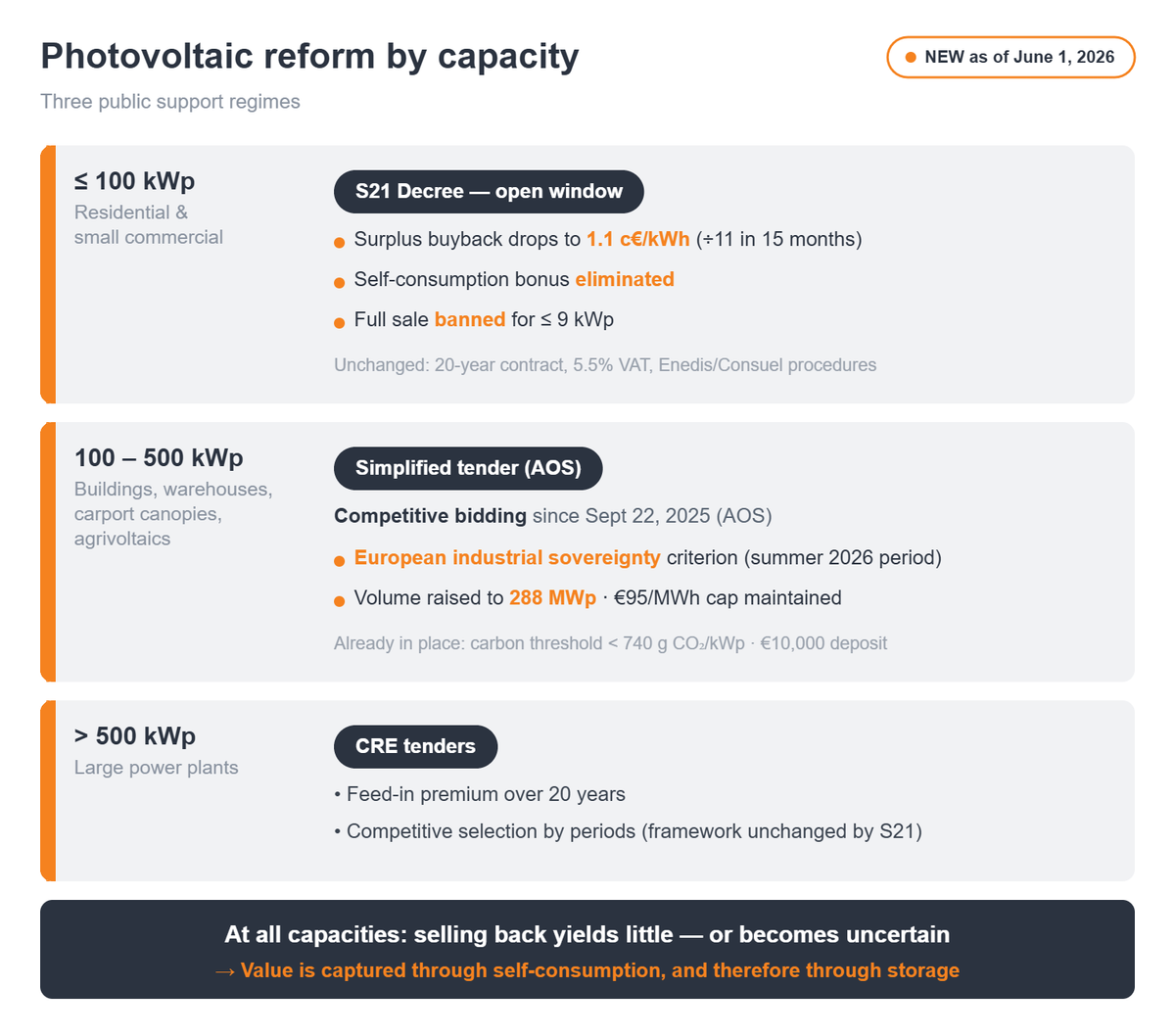
What does the S21 Order change for installations of 100 kWc or less?
In this bracket, the Order hits hardest, with three major developments. The first is the collapse of the buyback tariff. The S21 Order eliminates the CRE's former quarterly schedule and replaces it with a single tariff of 1.1 c€/kWh excl. tax, indexed at 2% per year, for sale with surplus injection over 20 years (Order of June 1, 2026).
The trajectory is clear: the buyback tariff fell from 12.69 c€/kWh before March 2025 to 1.1 c€/kWh since June 2026, a reduction by more than a factor of eleven in fifteen months (Official Journal, 2025–2026).
Second change: the self-consumption premium, paid at commissioning, is eliminated for any complete connection request submitted from June 4, 2026 onward. Files submitted before this date retain their acquired rights. Third change: total sale is no longer eligible for installations of 9 kWc or less; only sale with surplus injection remains accessible.
What does not change in this segment?
The 20-year buyback contract remains available.
The reduced-rate VAT remains accessible for eligible installations.
The administrative procedures (Enedis connection, Consuel) remain identical.
How are installations from 100 to 500 kWc supported?
This segment directly concerns professionals: large rooftops, agricultural sheds, parking carports. In this bracket, the S21 tariff Order no longer sets a buyback tariff. Since September 22, 2025, it is the simplified tender (AOS) that has replaced the open window for these installations (photovoltaique.info).
The principle has changed in nature. Where the open window automatically accepted any eligible project at a set tariff, projects between 100 and 500 kWc are now placed in competition and ranked according to the price proposed in €/MWh, with the cheapest offers given priority (CRE, AOS 100-500 kWc).
The candidate proposes a reference price in €/MWh, the basis for the supplementary remuneration if selected.
The CRE verifies the administrative and technical compliance of the files.
Compliant files are ranked by ascending price until the called volume is reached.
The June 2026 Order nonetheless remains decisive in this bracket, as it tightens the conditions for accessing public support. A financial implementation guarantee of €10,000 is required for any project over 100 kWc — local authorities may replace it with a deliberation approving the project — and installations must comply with a maximum emissions threshold of 740 kg CO₂/kWc over the entire life cycle (CRE, deliberation of July 29, 2025).
The second period, open from July 20 to 31, 2026, illustrates this tightening: the called volume rises to 288 MWc (compared to 192 MWc in the first period), the price cap remains at €95/MWh, and a resilience criterion linked to European industrial sovereignty is introduced (CRE, 2026).
What framework applies to plants over 500 kWc?
For the largest installations, the framework is stable and predates the S21 reform. Projects with a power above 500 kWc fall under the CRE tenders, with supplementary remuneration awarded over 20 years to the winners of a competitive selection organized in periods. The June 2026 Order does not modify this regime.
Why does the S21 Order shift value toward self-consumption?
Whatever the power, the observation is the same. Below 100 kWc, reselling brings in almost nothing anymore. Above it, selling your production is no longer an automatic right but a competitive, uncertain, and administratively demanding process.
The conclusion is shared across the industry: at 1.1 c€/kWh, the sale of surplus no longer constitutes a significant economic lever. The value of a project now rests on the electricity self-consumed and the savings achieved on the bill.
The gap is telling. For a professional, EDF's Tarif Bleu Pro on the Base option stands at €0.1583/kWh excl. VAT in June 2026, and a tertiary or industrial profile connected at low voltage often pays between €0.16 and €0.22/kWh all-in (Selectra / CRE, 2026). Each self-consumed kWh therefore avoids a purchase at this price level — whereas reselling it brings in only €0.011.
What role does stationary storage play in the face of the S21 Order?
This is where stationary storage comes in. Instead of injecting a devalued surplus onto the grid, it is kept to be released in the evening, at night, or during peak hours. A BESS (Battery Energy Storage System) captures the day's excess solar production and makes it available when the site needs it.
For a professional site, where volumes are large and the electricity bill a major cost item, the equation strengthens. Storage also allows several uses to be combined: increased self-consumption, peak/off-peak shifting (charging during off-peak hours, discharging during peak hours), and peak shaving, i.e. smoothing the peaks of subscribed power.
One final signal deserves the attention of project developers. With the carbon threshold of 740 kg CO₂/kWc and the new sovereignty criterion, the environmental footprint and the European origin of equipment are no longer mere arguments: they become criteria for market access. Second-life batteries from electric vehicles, repurposed into stationary storage, respond directly to this logic of reducing the carbon footprint through reuse. Battwoo designs this type of BESS system from requalified EV modules, with a cell-by-cell state-of-health (SoH) diagnosis.
Should you worry about the S21 Order for a professional solar project?
The S21 Order is not the end of solar, but the sign of a market that has reached maturity, one that no longer needs subsidies to be profitable. It shifts the center of gravity of the equation: producing to resell no longer makes sense, producing to consume more than ever. And between production and consumption, it is storage that makes the link, at every scale.
The tariffs, thresholds, and timelines cited correspond to the framework in force at the date of publication. As photovoltaic regulations change frequently, verify the provisions applicable to your project with official sources or your Battwoo contact.
Sources
CRE — Deliberation No. 2026-106, opinion on the specifications for the 2nd period of the "Petit PV" AOS (100-500 kWc) — https://www.cre.fr/fileadmin/Documents/Deliberations/2026/260521_2026-106__Avis_CDC_AOS_P2.pdf
CRE — Deliberation No. 2026-92, opinion on the amending order to the S21 Building tariff Order — https://www.cre.fr/fileadmin/Documents/Deliberations/2026/290426_2026-92_Avis_S21.pdf
photovoltaique.info — Simplified tender 100-500 kWc: principles and eligibility conditions — https://www.photovoltaique.info/fr/tarifs-dachat-et-autoconsommation/appels-doffres/appel-doffres-simplifie-100-500-kwc/principes-et-conditions-deligibilite/
photovoltaique.info — Simplified tender 100-500 kWc: results — https://www.photovoltaique.info/fr/tarifs-dachat-et-autoconsommation/appels-doffres/appel-doffres-simplifie-100-500-kwc/resultats/