
Capacity mechanism France: cutting the cost of winter peak days
Since 1 November 2026, the cost of France's capacity mechanism depends on your consumption on 22 winter peak days. A battery that discharges at those hours cuts this cost.
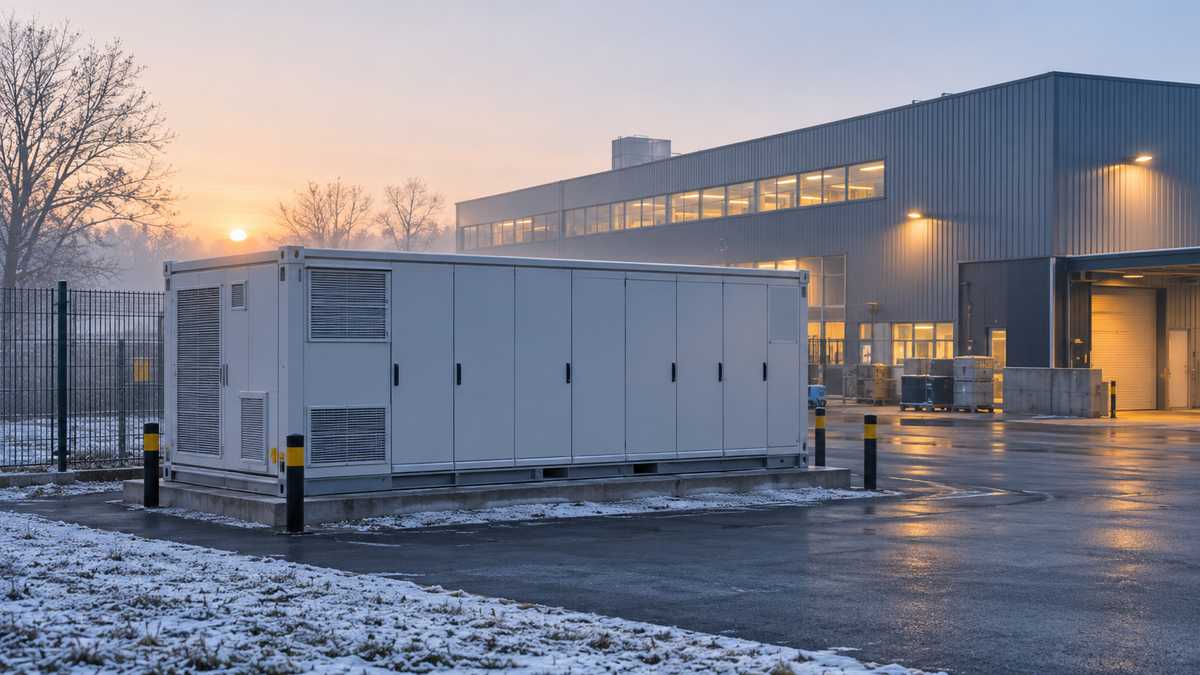
Since 1 November 2026, France's capacity mechanism has run under new rules. Its cost for a business now depends directly on its consumption during 22 winter peak days, over two three-hour windows. For winter 2026-2027, the auction run by RTE, France's transmission system operator, set the capacity price at €28,183/MW (RTE, auction of 6 July 2026). Every kW drawn at those hours now has a clear price. And every kW avoided is a saving.
What is France's new capacity mechanism?
The capacity mechanism is a scheme that pays power plants, storage and demand response to be available during winter consumption peaks, to guarantee security of electricity supply. It had existed since 2017 in a decentralised form. It was fully overhauled in 2026.
The European Commission approved the new scheme for ten years, from 1 November 2026 to 31 March 2036 (European Commission, decision SA.117564 of 22 December 2025, cited by the CRE, deliberation no. 2026-24, in French). Three structural changes:
- A single buyer: RTE contracts the required capacity itself through centralised auctions, instead of obligations spread across suppliers.
- A cost-allocation tax: the cost is funded by a tax paid by suppliers, large consumers and network operators, then passed on to bills.
- A single annual price: the capacity price, called the quotient, is the same for every supplier and is confirmed by the CRE, France's energy regulator, by 1 October before each winter.
How much does the capacity mechanism cost in 2026-2027?
For winter 2026-2027, the mechanism represents about €1.67 billion to fund (CRE, deliberation of 10 September 2026). A single auction took place, on 6 July 2026. It selected 82,446.8 MW of capacity at a clearing price of €28,182.99/MW (RTE, 2026).
This auction price is not the one passed on to consumers. Payment to existing capacity is capped at €15,000/MW by ministerial order. The overall price charged to contributors, the quotient, stands at €18,646.63/MW including VAT for winter 2026-2027 (CRE, deliberation no. 2026-148 of 15 July 2026, in French).
Per unit, that is about €18.65 per kW of power drawn during peaks, for one winter. For consumers on regulated tariffs, the CRE put the average effect at +€3.45/MWh excluding tax (CRE, deliberation no. 2026-147 of 15 July 2026).
Why does consuming on peak days cost more?
Because each supplier's contribution is calculated on its customers' consumption during peak periods, not on their annual consumption. The supplier then passes this cost on according to the terms of the supply contract.
Peak periods are strictly defined (RTE, capacity mechanism rules 2026):
- Period: the "electricity winter", from 1 November to 31 March.
- Number of days: up to 22 peak days per winter, including 6 in November-December and 16 from January to March.
- Windows: 07:00-10:00 and 17:00-20:00, i.e. 6 hours per peak day.
- Notice: RTE announces each peak day the day before.
In total, the cost base is set over at most 132 hours a year. A site drawing heavily at 08:00 or 18:00 on a very cold day carries a larger share of the cost than a site with the same consumption at other times. That is the stated aim of the reform: to place the cost on consumers who call on the system at its most critical moments.
The capacity mechanism does not charge for kWh, but for being on the grid at specific hours. Reducing your power draw over 132 hours a year is enough to act on this cost.
How does a battery reduce the cost of the capacity mechanism?
A stationary battery reduces this cost by discharging during peak windows: the site draws less from the grid at 07:00-10:00 and 17:00-20:00, which lowers the base for its contribution. A BESS (Battery Energy Storage System, a stationary battery installation) then recharges outside those windows.
The logic is the same as peak shaving, which smooths a site's power peaks. But here the target is a national calendar, not the site's own peak. A typical peak day runs as follows:
- Day before, late afternoon: RTE announces the peak day. The control system schedules the next day's discharge.
- Night, off-peak hours: the battery charges to full capacity at the lowest rate.
- 07:00-10:00: the battery powers the site and reduces grid draw accordingly.
- 10:00-17:00: the battery recharges, from the grid or from on-site solar if available.
- 17:00-20:00: second discharge, over the second peak window.
Each peak window lasts three hours. That matches the discharge time of Battwoo systems, which operate at C/3 (full discharge in three hours). The seven-hour gap between the two windows leaves time for a full recharge at the same rate. The BMS (battery management system) tracks the state of charge of each module to guarantee availability at the right time.
What savings can a business site expect?
Savings depend on the power reduced during peaks and on how the supply contract passes the cost on. Here is a simplified order of magnitude, based on the 2026-2027 quotient:
- Reference site: 400 kW drawn on average during peaks, i.e. about €7,460 of contribution over the winter (400 kW × €18.65/kW).
- With a 300 kWh battery: 100 kW discharged over each three-hour window, i.e. about €1,865 of contribution avoided per winter.
- Cycles used: at most 44 cycles per winter (22 days × 2 windows), a small share of a 5,000-cycle guarantee.
This figure alone does not justify an investment. It adds to the other uses of the same battery: peak shaving of contracted power, peak/off-peak time-of-use shifting, solar self-consumption. Peak days fall in winter, when solar output is low. The battery is then free for this use without competing with summer self-consumption.
Can storage also be paid by the capacity mechanism?
Yes, under conditions: storage capacity can be certified and contracted by RTE, directly or through an aggregator. The scheme even reserves a dedicated volume for it at the final auction.
For winter 2026-2027, an order of 18 March 2026 set a 4.7 GW target for demand response and storage capacity reserved at that auction. The regulatory signal is clear: low-carbon flexibility is part of security of supply. An equipped site then has two levers: reduce its contribution as a consumer, and earn revenue from its battery's flexibility as capacity.
What should you do this winter?
Winter 2026-2027 is the first winter under the new scheme, and the first 6 peak days can fall before the end of December. Three practical steps:
- Read your supply contract: check how the "capacity mechanism" line is calculated and passed on (flat rate, actual cost, all-inclusive fixed price).
- Measure your power at peak hours: extract your load curve and isolate consumption at 07:00-10:00 and 17:00-20:00 on cold days.
- Price the stacked use cases: assess a battery on all its revenue streams (capacity, peak shaving, time-of-use shifting, self-consumption), over the life of the mechanism to 2036.
Battwoo carries out this assessment from your load curve. Contact our team for a sizing study.
FAQ on the capacity mechanism and peak days
What is a capacity mechanism peak day?
It is a day in the electricity winter, from 1 November to 31 March, when the balance between supply and demand is tightest. RTE designates up to 22 per winter and announces them the day before. The windows concerned are 07:00-10:00 and 17:00-20:00.
What is the capacity price for winter 2026-2027?
The auction of 6 July 2026 cleared at €28,182.99/MW. The quotient passed on to contributors, after capping existing capacity at €15,000/MW, is €18,646.63/MW including VAT (CRE, 2026).
How long will the new capacity mechanism last?
The European Commission approved it for ten years, from 1 November 2026 to 31 March 2036. A capacity price is set each year before winter begins.
Do all businesses pay for the capacity mechanism?
Yes, all consumers contribute, through their supplier or directly for the largest ones. The amount depends on consumption during peak periods and on the terms of the supply contract.
Is a three-hour battery enough to cover a peak day?
It covers one full three-hour window. To cover both windows on the same day, it recharges between 10:00 and 17:00, a seven-hour gap that is enough at C/3.
Does the lower contribution alone pay back a battery?
Rarely on its own. A battery's return is built on stacked use cases: peak shaving, time-of-use shifting, self-consumption and capacity. The capacity mechanism adds a predictable revenue stream until 2036.