
Battery Storage Price: What the Quote Actually Covers
A commercial BESS runs roughly €300–500 per kWh installed. That figure means nothing without the exact scope of the quote and proper site sizing.
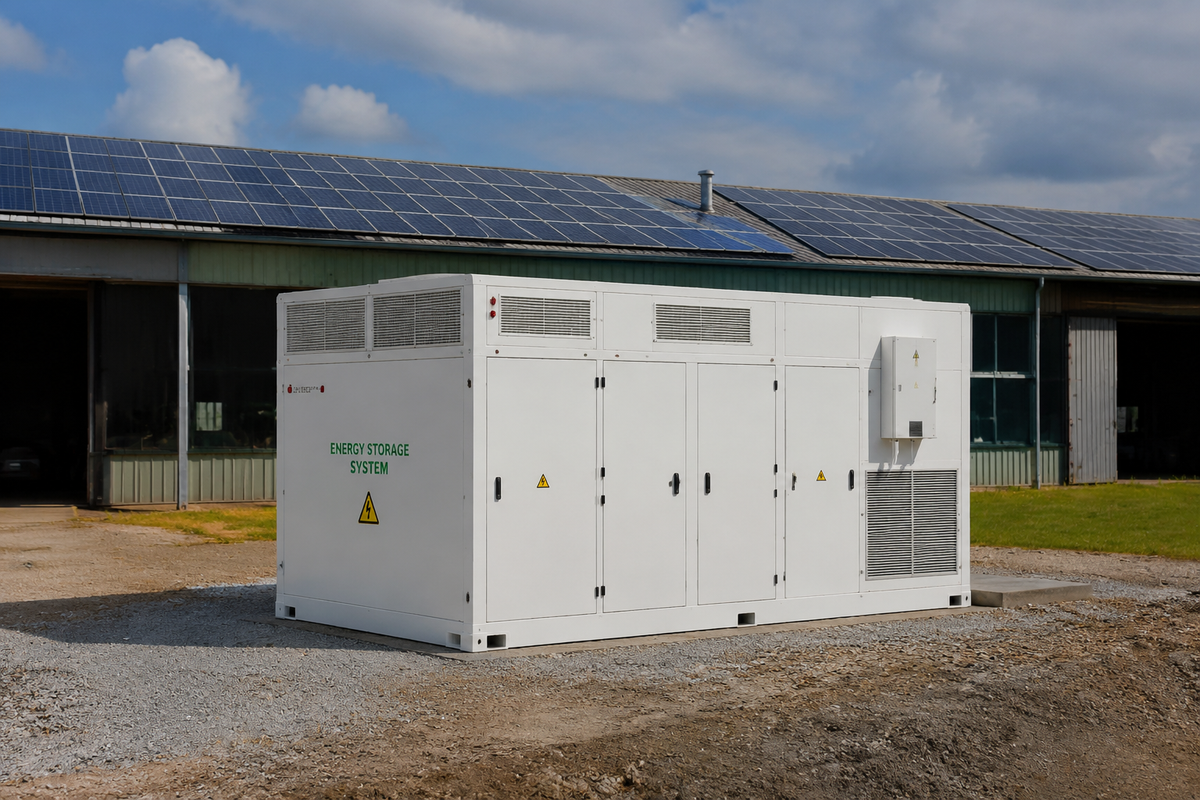
An enterprise BESS (Battery Energy Storage System) currently ranges from around €300 to €500 per installed kWh in France for a commercial and industrial (C&I) project. This range is an order of magnitude, not a fixed price. It can vary by a factor of two depending on the size of the project and, above all, what the quote actually includes. The question of the price of a storage battery actually hides three underlying questions: how much the hardware costs, how much the delivered project costs, and how much the system generates once in operation.
How much does a storage battery cost in 2026?
Battery prices have been dropping continuously and rapidly. According to the annual BloombergNEF survey published in December 2025, the prices of lithium-ion packs have fallen by 93% since 2010. The stationary storage segment recorded the sharpest drop of all segments that year, at around 45% year-on-year, becoming for the first time the cheapest segment on the market, ahead of the automotive sector.
For the complete system, the average global price of a turnkey BESS dropped by about 31% year-on-year in 2025, reaching its lowest level since the survey was launched in 2017 (BloombergNEF, Energy Storage System Cost Survey 2025).
For a C&I project in France, the orders of magnitude observed on the market in 2026 are as follows:
- System of around 1 MWh: approximately €300 to €400/kWh installed
- System of around 50 kWh: approximately €450 to €550/kWh installed
- Hardware only, excluding installation and commissioning: significantly lower range, with the gap compared to the delivered project potentially exceeding a factor of two
The logic to remember: the unit cost decreases as the project size increases, and the gap between the hardware price and the delivered project price is considerable. This is exactly what a poorly framed quote comparison hides.
What does the price of a storage battery cover?
A storage project is broken down into three distinct expense categories. Comparing two offers requires verifying that all three are present in each.
- Feasibility study: analysis of the consumption profile, sizing, profitability calculation
- Manufacturing and supply: modules, BMS (Battery Management System), cabinet, HVAC (climate control), protections, inverters, Energy management syst (EMS)
- Installation service: delivery, connection, commissioning, testing
In the traditional market structure, the manufacturer sells the battery to an installer—often a photovoltaic installer moving into this market adjacent to solar. The installer conducts the study, sizes the system, and then installs it. Depending on the provider, the announced price may therefore not cover the same scope.
Comparing an ex-works price per kWh with a turnkey service amounts to comparing two different products. This is the most frequent mistake made during the consultation phase.
Which lines to check before comparing two quotes?
Before any comparison, list line by line what each offer includes:
- Preliminary technical and financial study
- PCS (Power Conversion System) or hybrid inverter
- EMS (Energy Management System) and control software
- AC protection cabinet and connection equipment
- Civil engineering, concrete slab, technical room, or shelter
- Commissioning, acceptance testing, operator training
- Maintenance, capacity warranties, and commitment duration
The apparent price difference between two offers is often entirely explained by what is missing from the cheaper column.
Why the price per kWh is not the only decision metric
The purchase price is only half of the equation. The other half is the revenue or savings generated over the system's lifespan. A battery with an attractive price per kWh but poorly sized may yield no returns.
The most common case: a solar plant that is undersized compared to the site's consumption. The producer is already directly consuming almost everything their panels produce. There is therefore no surplus to store, and installing a battery serves no purpose, regardless of its price per kWh.
The relevant metrics for decision-making are therefore:
- Return on Investment (ROI) time, expressed in years
- The Internal Rate of Return (IRR) of the project over its operational lifespan
- The LCOS (Levelized Cost of Storage, the discounted cost of the kWh discharged over the system's lifespan)
- Net annual savings, broken down by use case: self-consumption, peak shaving, TOU (Time-of-Use) shifting, grid flexibility
These metrics cannot be deduced from a catalog. They are calculated based on the site's actual load curve, at the most granular time step available.
How Battwoo structures its pricing
Battwoo designs, manufactures, and installs stationary storage systems using second-life electric vehicle battery modules. Three choices structure the final price.
Analysis precedes the quote
We start with the consumption profile and, where applicable, the site's solar production profile. The deliverable is a technical and financial report detailing the metrics necessary for decision-making. If the analysis concludes that a battery has no economic benefit for the site, we state this before issuing a quote.
Manufacturing is sized to the actual need
Each unit is built for a specific project. If the analysis recommends 440 usable kWh, the system will be 440 kWh. A standard off-the-shelf reference would offer 400 kWh, which is insufficient, or 500 kWh, including 60 kWh that would never be used but still billed and amortized.
Installation is done in-house
There is no intermediary installer taking a margin on the hardware. This has operational as well as economic consequences: the team that sized the system is the same one that commissions it.
Cumulative effect on a complete project — including study, supply, and installation, for a capacity of 500 kWh to 1 MWh — we are roughly 30% below observed market prices. This difference comes from eliminating an intermediary's margin, avoiding billing for oversized capacity, and the structurally lower supply cost of second-life modules compared to new cells.
Key takeaways on the price of a storage battery
- The French C&I market sits around €300 to €500/kWh installed in 2026, decreasing as size increases
- This figure only makes sense when associated with an explicit service scope
- Three items must be included in any comparable offer: study, supply, and installation
- The decision criterion is the economic return of the properly sized system, not the unit price of the stored kWh
To evaluate the relevance of a storage system for your site, we carry out a preliminary technical and financial study based on your load curve. Request a preliminary study.
Sources
1. BloombergNEF — 2025 Lithium-Ion Battery Price Survey (9 December 2025)
93% decline in lithium-ion pack prices since 2010; 45% year-on-year drop in the stationary storage segment, now the cheapest on the market.
https://about.bnef.com/insights/clean-transport/lithium-ion-battery-pack-prices-fall-to-108-per-kilowatt-hour-despite-rising-metal-prices-bloombergnef/
2. Energy-Storage.News — coverage of the BNEF Energy Storage Systems Cost Survey 2025 (16 December 2025)
31% year-on-year decline in the global average price of a turnkey BESS, the lowest level since 2017.
https://www.energy-storage.news/battery-storage-system-prices-continue-to-fall-sharply-bnef-and-ember-reports-find/
3. Acieb Énergie — Battery storage for businesses: BESS guide 2026 (18 March 2026)
Range of €300-500/kWh installed for LFP technology; cost decreases with scale (€300-400/kWh at 1 MWh, €450-550/kWh at 50 kWh).
https://www.aciebenergie.fr/guides/stockage-batterie-entreprise-guide-bess-2026/
4. PVB — What does a C&I BESS really cost in Europe in 2026? (updated June 2026)
Gap between hardware cost and delivered project cost; the pitfall of comparing quotes on €/kWh alone when scopes differ.
https://pvb.com/fr/article/Combien-co%C3%BBte-r%C3%A9ellement-un-CI-BESS-en-Europe-en-2026--Guide-des-co%C3%BBts-d'installation-totaux-pour-les-CFOS-(mis-%C3%A0-jour-en-juin-2026)./